Wednesday, March 9, 2016

Blog 20 – Fourth Interview Questions

~The B-21 is a long range strategic bomber under development by Northrop Grumman.

As with each blog, you should choose an interesting visual to entice people to read what you have written.


  1. Who do you plan to interview?  What is this person's area of expertise?
    1. I am unsure about who I will be interviewing next; however, it will most likely be one of my mentor’s coworkers. Since I’m not sure about who I am going to interview yet, I cannot really tell what my interviewee’s exact expertise is, but I know that he/she will be working with the aerospace industry(most likely manufacturing or design/research).
  2. Post 20 open-ended questions you want to ask an expert in the field concerning your senior project. Your focus should be finding answers to your EQ.
    1. How will biofuels change commercial and military aviation?
    2. How long do you think will it take for biofuels to before the primary source of fuels?
    3. Are there any other alternative energy sources that may be used in future aircraft?
    4. What is the biggest factor to consider when increasing aircraft fuel efficiency?
    5. How else can fuel efficiency be increased in aircraft?
    6. How can aircraft be more cost efficient?
    7. How has the aerospace industry evolve in order to meet stringent regulations?
    8. In what ways has the aircraft industry worsened?
    9. How can the aircraft industry further improve?
    10. What is the biggest problem that the aircraft industry has today?
    11. How can additive manufacturing improve the aerospace industry?
    12. Would the changes in technology be too costly?
    13. How do the commercial and military aircraft industry differ in terms of efficiency?
    14. Should the aerospace industry focus more on increasing strength/stiffness performance or increasing fuel efficiency through more aerodynamic designs and/or efficient engines?
    15. What are geared turbofan engines?
    16. Why are turbofans used more?
    17. Are there other types of engines that may be more efficient?
    18. How can the increase in biofuel use affect the designs of aircraft engines?
    19. What other fuel sources are there for the aircraft industry?
    20. What other thoughts/comments do you have about aircraft efficiency/cost efficiency?


If you have already interviewed someone two times, you aren't allowed to interview that same person without House teacher approval.

The interview itself is not due until Friday, April 15th to turnitin.com. However, we want to give you as much time as possible, so we are asking you to complete the blog now. Remember that in addition to turning in the interview to turnitin.com, you also need to turn in the verification sheet to your House teacher and post an audio excerpt of no less than 5 minutes on your senior project blog.

Wednesday, March 2, 2016

Blog 19 – Third Answer


~The Pratt & Whitney PW1000G is a high-bypass geared turbofan engine family. Unlike older turbofan engines, geared turbofan engines are more fuel efficient and deliver reduced ground noise. 

  1. EQ
    1. How can aircraft manufacturers utilize today’s technology in order to be cost efficient?
  2. Answer #3 (Write in a complete sentence like a thesis statement)*\
    1. Aircraft manufacturers can achieve cost efficiency with today’s technology through the use of more advanced aircraft engines, such as geared turbofan engines. Advanced aircraft engined designs like geared turbofan engines significantly increase the fuel efficiency and power output(thrust generated) of aircraft.
  3. 3 details to support the answer
    1. Low fuel consumption
      1. Low greenhouse gas emissions
    2. Compact and lightweight designs
      1. Thinner/lighter nacelles as engine bypass ratio and fan diameter grow.
      2. Decreases drag generated by awkward/ineffective engine designs.
    3. Can be easily implemented to current aircraft systems, as engine replacements are much more simpler than entire system changes.
      1. i.e. Current commercial aircraft cross section structures cannot be changed/altered because they serve as the skeleton/supporting structure.
  4. The research source(s) to support your details and answer
    1. Hughes, Chris. "Geared Turbofan Technology." NASA Ames Research Center, 8 Sept. 2010. Web. 02 March 2016. <http://www.aeronautics.nasa.gov/pdf/hughes_green_aviation_summit.pdf>.
  5. Concluding Sentence
    1. Although my third answer to the essential question points to an entirely new direction, I thought that it was still important because unlike my other two answers(efficient design through complex geometrical shapes and additive manufacturing), my last answer(advanced aircraft engines) is probably the most applicable/suitable option for the aerospace industry today. To explain, my third answer to the essential question is different from the first two in a sense that the first two answers can’t really address the issues that aircraft today have. It’s easy to design and create an efficient design through the use of additive manufacturing processes and complex geometrical shapes; however, it’s impossible to modify the inner structures of already existing aircraft. In other words, my first and second answer can only be used for aircraft that are yet to be manufactured. On the other hand, since my third answer deals with a more accessible part of aircraft. In most cases, it is cheaper to change an aircraft engine than to change an entire aircraft.

Wednesday, February 24, 2016

Blog 18 – Answer 2


~There are many advantages that come with additive manufacturing, including: more complex designs, variety, few constraints, less waste, less fabrication time, etc.

  1. What is your EQ?
    1. “How can aircraft manufacturers utilize today’s technology in order to be cost efficient?”
  2. What is your first answer? (In complete thesis statement format)
    1. Aircraft manufacturers can maximize cost efficiency with today’s technology through the use of efficient designs that utilize certain geometric shapes, like Laminates, T-stiffened, and Honeycomb structures.
  3. What is your second answer? (In complete thesis statement format)
    1. Aircraft manufacturers can maximize cost efficiency with today’s technology through the use of additive manufacturing techniques.
  4. List three reasons your answer is true with a real-world application for each.
    1. My answers are already based on real world applications. For example:
      1. The geometric factors that contribute to efficiency are not only found in Aerospace applications, but also in the automotive, construction, and other manufacturing industries. All three designs of my first answer are widely used in aircraft, spacecraft, automobiles, etc.
      2. The correlation between the geometrical shapes and aircraft cost efficiency is confirmed by real-world scientific and empirical testing.
        1. Use of these geometrical factors can significantly lower the overall cost/weight of aircraft, while still retaining its overall strength/stiffness.
        2. My independent component actually tests the strength and stiffness values of each shape.
      3. All three geometric shapes use composite materials, which already improve the cost/performance ratio of aircraft components.
        1. Composite materials are found everywhere
          1. i.e. aircraft/military, appliance/electrical components, automotive/transportation, civil infrastructure, construction, consumer products, and marine equipment.
    2. My second answer, additive manufacturing, is true because:
      1. It is a great improvement over other forms of manufacturing/shaping(i.e.subtractive and formative)
        1. i.e. 3D printing
      2. Allows for more efficient internal geometrical shapes in aircraft components.
        1. Subtractive and formative shaping techniques are very limited in the type of designs they can implement since most internal components are impossible to reach.
        2. i.e. Airbus innovation ideas--utilize complex geometrical shapes for inner parts of components (panels, skins, etc.). These are designs that are impossible to implement with subtractive and formative manufacturing.
      3. Additive manufacturing techniques are constantly being improved in time. With each year, more and more aircraft manufacturers are using additive manufacturing techniques to create complex aircraft components.
        1. i.e. Airbus, Boeing, and Northrop Grumman are all trying to find an effective method to create an aircraft entirely through additive manufacturing techniques.
  5. What printed source best supports your answer?
    1. Ruplu Bhattacharya and Mohan Wamsi. "Primer: 3D printing, Early days for a disruptive space." Bank of America Meryll Lynch, 2013. PDF File.
  6. What other source supports your answer?
    1. “Composite Materials Handbook Volume 3. Polymer Matrix Composites Materials Usage, Design, and Analysis 2.4.1.1 Carbon and Graphite Fibers.” United States Department of Defense, 17 June 2002. PDF File.
    2. Federal Aviation Administration, U.S. Department of Transportation. "Aviation Maintenance Technician Handbook - Airframe, Volume 2 Chapter 1: Aircraft Structures." DOT, FAA, 2012. PDF File.
    3. Gjøvik, Raufoss. "Additive Manufacturing Technology Industrial demonstrators and Living labs." SFI Norman, 2008. PDF File.
    4. J.F.M. Wiggenraad, P. Arendsen and J.M. da Silva Pereira. "Design optimization of stiffened composite panels with buckling and damage tolerance constraints." National Aerospace Laboratory NLR, 1998. PDF File.
  7. Tie this together with a  concluding thought.
    1. While my first and second answers may overlap in some aspects, I decided to use them separately because of the amount of information about each of them. There are so many factors to take into consideration when talking about efficient designs and geometrical factors. Moreover, many of the geometrical shapes I have talked about in my first answer can actually be fabricated without additive manufacturing techniques. Additive manufacturing is also a very big answer as they hold so many strengths over other manufacturing/shaping techniques.

Thursday, February 18, 2016

Blog 17 – Interview 3 Reflection


~I plan on further exploring the benefits of additive manufacturing for my 2nd answer to my essential question, "How can aircraft manufacturers utilize today's technology in order to be cost efficient?"

  1. What is the most important thing I learned from the interview?
    1. The most important thing I learned from the interview is that it is actually hard to employ additive manufacturing means/processes due to stringent requirements that regulators put on the aircraft industry. It is hard for regulators to accept newer cutting-edge technology because of their lack of users--which makes it harder for the technology to be tested.
  2. How has your approach to interviewing changed over the course of your senior project?
    1. Over the course of my senior project, I have learned how to ask better open ended questions. Moreover, I also believe that I am more able to confidently approach/talk to other experts about my senior project.

Wednesday, February 10, 2016

Blog 16 – Independent Component 2 Approval


The empennage, commonly known as the tail assembly, is the rear section of the aircraft body. It's main purpose is to provide stability to the aircraft.


  1. Describe in detail what you plan to do for your 30 hours.
    1. For my 2nd Independent Component, I plan on doing work that is similar to that of my 1st I.C.--empirical testing/experimentation on certain aircraft components that improves the efficiency of the overall design of an aircraft. It will be different in a sense that I will no longer be doing research on cross-section structures but rather a completely different component found on aircraft. I will also do research on the materials that can/will be used for these components. I am still unsure about which specific component I want to do research on, but it will most likely be on the empennage of aircraft.
  2. Discuss how or what you will do to meet the expectation of showing 30 hours of evidence.
    1. Since my 2nd Independent Component will be very similar to my first, I plan on meeting the expectation of showing 30 hours of evidence through literary work (notes, statistics, etc.) and empirical evidence. I plan on doing annotations on documents that I will use throughout the project and also take additional notes.
    2. The structure of my 2nd Independent Component is also the same as the 1st Independent component:
      1. Research/Design - This phase will take the most time. At least half of the 30 hours will most likely be spent on the research and design phase. This will also include discussions and brainstorming sessions I will have with my mentor, Eric Fodran.
      2. Building - I am unsure of how long the building phase will take. This will most likely take the least amount of time compared to the other phases.
      3. Testing/Experimentation - Testing and experimentation is one of the most important phases as this will show if my research is correct.
      4. Results and additional work - This is the conclusion of my 2nd independent component. I will most likely take additional notes that can be used as reference for my final presentation. For example, in addition to the research I will be doing on efficient designs, I will most likely have to look into the economics of each designs and explain how their performance affects the cost of each component.
  3. Explain how this component will help you explore your topic in more depth.
    1. I believe that this component will help me explore my topic in more depth as it is a direct result of countless hours of research. I believe that it will show me the true significance of efficiency in Aerospace and manufacturing.
  4. Post a log in your Senior Project Hours link and label it "Independent Component 2" log.
    1. Done.
    2. Senior Project Hours

Thursday, February 4, 2016

Independent Component 1

~All of the materials we will use for empirical testing/experimentation. These are all of the printed/manufactured coupons(test samples).

"How can aircraft manufacturers utilize today's technology in order to be cost efficient?"


LITERAL
  • (a) Write: “I, Justin Ilagan, affirm that I completed my independent component which represents 34 hours of work.”
  • (b) Cite your source regarding who or what article or book helped you complete the independent component.
    1. “Composite Materials Handbook Volume 3. Polymer Matrix Composites Materials Usage, Design, and Analysis.” United States Department of Defense, 17 June 2002. PDF File.
    2. J.F.M. Wiggenraad, P. Arendsen and J.M. da Silva Pereira. "Design optimization of stiffened composite panels with buckling and damage tolerance constraints." National Aerospace Laboratory NLR, 1998. PDF File.
    3. Federal Aviation Administration, U.S. Department of Transportation. "Aviation Maintenance Technician Handbook - Airframe, Volume 2 Chapter 1: Aircraft Structures." DOT, FAA, 2012. PDF File. <http://www.faa.gov/regulations_policies/handbooks_manuals/aircraft/amt_airframe_handbook/media/ama_ch01.pdf><http://www.faa.gov/regulations_policies/handbooks_manuals/aircraft/amt_airframe_handbook/>.
    4. Federal Aviation Administration, U.S. Department of Transportation. "Aviation Maintenance Technician Handbook - Airframe, Volume 2 Chapter 5: Welding." DOT, FAA, 2012. PDF File. <http://www.faa.gov/regulations_policies/handbooks_manuals/aircraft/amt_airframe_handbook/media/ama_ch01.pdf><http://www.faa.gov/regulations_policies/handbooks_manuals/aircraft/amt_airframe_handbook/>.
    5. Gjøvik, Raufoss. "Additive Manufacturing Technology Industrial demonstrators and Living labs." SFI Norman, 2008. PDF File.
    6. Palmer, Dave. "Strength & Stiffness: What's the Difference?" DesignNews. DesignNews, 17 Sept. 2014. Web. 03 Dec 2015. 
    7. Ruplu Bhattacharya and Mohan Wamsi. "Primer: 3D printing, Early days for a disruptive space." Bank of America Meryll Lynch, 2013. PDF File. <http://www.designnews.com/author.asp?section_id=1365&doc_id=274793&dfpPParams=ind_183,aid_274793&dfpLayout=blog>.
    8. Woodford, Chris. “Composites and Laminates.” Explainthatstuff. Explainthatstuff, 13 July 2015. Web. 31 Jan 2016. <http://www.explainthatstuff.com/composites.html>.
  • (c) Update your hours in your Senior Project Hours link. Make sure it is clearly labeled with hours for individual sessions as well as total hours.
    1. Done
  • (d) Explain what you completed.    
    1. I have done extensive research on aircraft wing spar structures and other types of supporting structures. I went through hundreds of designs in which all had different structure configurations. I drafted the best baseline designs possible for experimentation and have revised them. With the help of my mentor, I was able to have these baseline designs manufactured and ready to be tested in a lab.
INTERPRETIVE
  • Defend your work and explain its significance to your project and how it demonstrates 30 hours of work.   Provide evidence (photos, transcript, art work, videos, etc) of the 30 hours of work.
    1. More than half of the time spent on my Independent Component 1 can only be proven by looking at the sources/references used for my research. This is because of the amount of reading I had to do. Most of the sources I used for IC1 were about 40 pages. Moreover, I have spent countless hours note-taking and drafting my designs. I have also spent about 8-10 hours doing discussions with my mentor, Eric Fodran. Below, you can find evidence of some of the notes I have taken, as well as the drafts and the manufactured coupons(test samples). The sources I used for my IC1 can be found above--question (b).
    2. Online Notes/Outlines
      • https://docs.google.com/document/d/1C77BCYo0GdDtuForBemo4F1Bdfyq2tJ7LjggxD8YOy4/edit?usp=sharing
      • https://docs.google.com/document/d/1xeCVZPdlj3rW67eabr_wtz01P5LKoMs-LJKgGhOhtJU/edit?usp=sharing
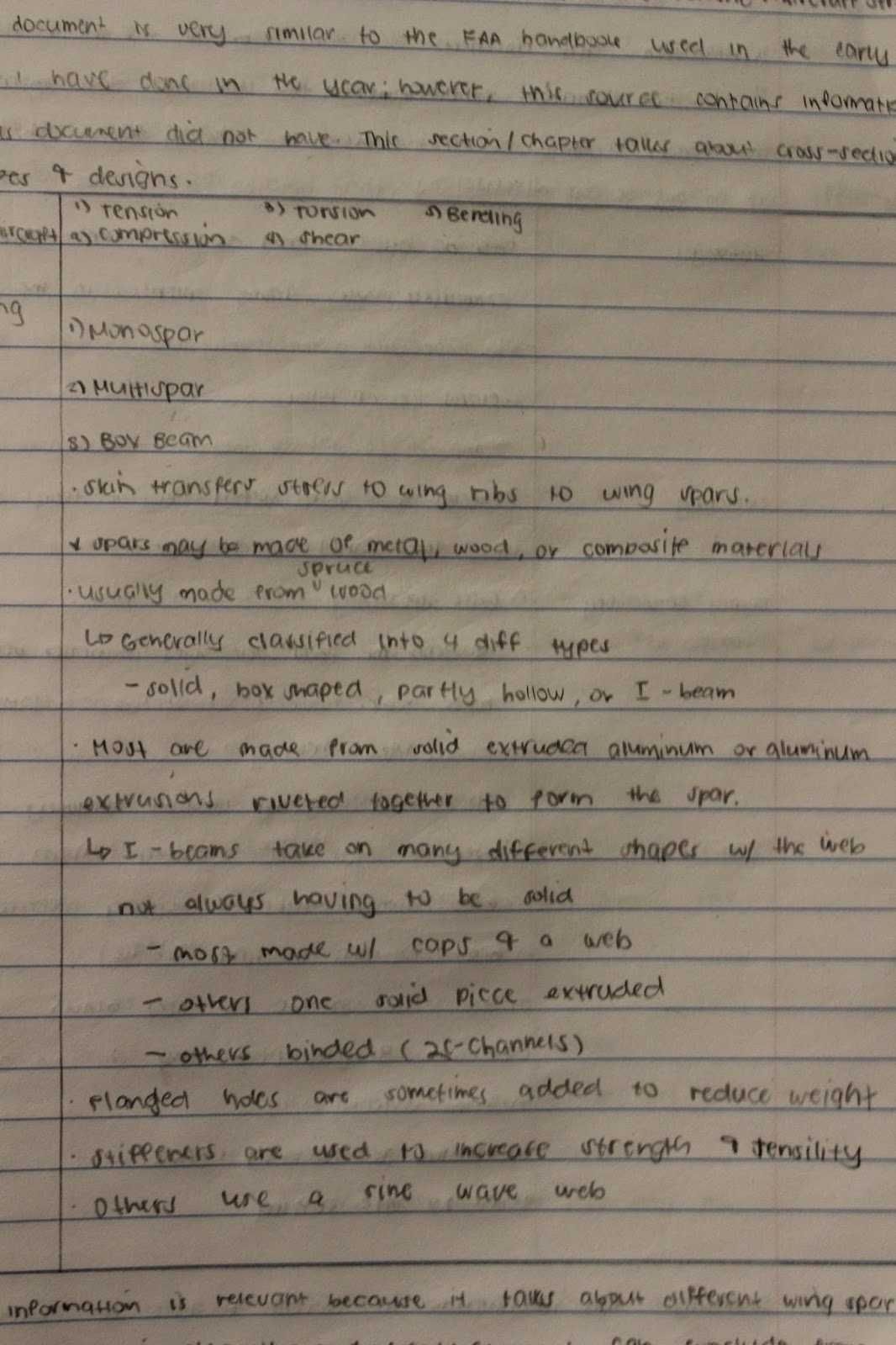
    3. Notes
    4. ~Gjøvik, Raufoss. "Additive Manufacturing Technology Industrial demonstrators and Living labs." SFI Norman, 2008. PDF File.
      ~Gjøvik, Raufoss. "Additive Manufacturing Technology Industrial demonstrators and Living labs." SFI Norman, 2008. PDF File. 
      ~Palmer, Dave. "Strength & Stiffness: What's the Difference?" DesignNews. DesignNews, 17 Sept. 2014. Web. 03 Dec 2015. Ruplu Bhattacharya and Mohan Wamsi. "Primer: 3D printing, Early days for a disruptive space." Bank of America Meryll Lynch, 2013. PDF File.
      ~Ruplu Bhattacharya and Mohan Wamsi. "Primer: 3D printing, Early days for a disruptive space." Bank of America Meryll Lynch, 2013. PDF File. 
      ~Ruplu Bhattacharya and Mohan Wamsi. "Primer: 3D printing, Early days for a disruptive space." Bank of America Meryll Lynch, 2013. PDF File. 
      ~Federal Aviation Administration, U.S. Department of Transportation. "Aviation Maintenance Technician Handbook - Airframe, Volume 2 Chapter 1: Aircraft Structures." DOT, FAA, 2012. PDF File.  
      ~Federal Aviation Administration, U.S. Department of Transportation. "Aviation Maintenance Technician Handbook - Airframe, Volume 2 Chapter 5: Welding." DOT, FAA, 2012. PDF File.
      ~J.F.M. Wiggenraad, P. Arendsen and J.M. da Silva Pereira. "Design optimization of stiffened composite panels with buckling and damage tolerance constraints." National Aerospace Laboratory NLR, 1998. PDF File.
    5. Draft 1
    6. ~Draft 1
    7. Draft 2
    8. ~Draft 1 revision
    9. Printed/Manufactured objects
    10. ~All of the materials we will use for empirical testing/experimentation. These are all of the printed/manufactured coupons.
      ~Topside view of woven laminate coupons
      ~Angled view of woven laminate coupons
      ~Topside view of unidirectional laminate coupons 
      ~Angled view of unidirectional laminate coupons

      ~Topside view of T-stiffened
      ~Angled view of T-stiffened
      ~Cross-section view of T-stiffened

      ~Topside view of reinforced honeycomb structure
      ~Angled view of reinforced honeycomb structure
      ~Cross-section view of reinforced honeycomb structure
APPLIED

  • How did the component help you understand the foundation of your topic better?  Please include specific examples to illustrate this.
    1. With the research I have done for my Independent Component 1(I.C.1), I have gained a better understanding on how certain geometrical factors can significantly decrease the overall weight of an aircraft. Before starting on I.C.1, I wasn’t aware of how much composites can improve the weight/performance ratio of certain components. This project really opened up many possible answers that I can use for my essential question. It gave me a new perspective and something different to look for in my research. An example would be the vast topic of additive manufacturing. When comparing additive shaping techniques to subtractive shaping, it is evident that any aircraft manufacturer can increase profitability of their aircraft in the long run. Information on additive/subtractive manufacturing can be found on "Additive Manufacturing Technology Industrial demonstrators and Living labs" by Raufoss Gjøvik, and "Primer: 3D printing, Early days for a disruptive space" by Ruplu Bhattacharya and Mohan Wamsi. Another way my IC1 helped me understand the foundation of my topic better would be by introducing the importance of strength/stiffness to weight ratio of aircraft components. Like I have said before, before doing my Independent Component 1, I was looking at completely different answers(i.e. aerodynamics, engines, etc.); however, my IC1 has opened up a wide array of possible answers to my essential question. Information on strength and stiffness can be found on "Strength & Stiffness: What's the Difference?" by Dave Palmer. While there are many other ways that my Independent Component 1 has helped me understand the foundation of my topic(Aerospace Engineering), I find that the 2 reasons states above are most significant.